Industry: restaurants · March 30, 2026
ADA Compliance for Restaurants: The 12 Things Inspectors Check First
Where do restaurants most often fail ADA inspection?
Restaurants get cited most often on parking access aisles, entrance door force, counter heights, restroom turning radius, and online menus. None of these are expensive fixes if caught proactively — but they are the top five findings across our audits.
Restaurants operate on thin margins, and accessibility work often looks like an expense with no upside. In practice, the opposite is true: lawsuits are expensive, customers with disabilities are a meaningful revenue stream, and the fixes that matter most are cheap. Here is the prioritized punch list we run through on a typical restaurant audit.
Outside: parking and approach
- Accessible parking ratio. One accessible space per 25 total spaces (the ratio shifts in larger lots). At least one of those must be van-accessible.
- Access aisle width. Van spaces need an 8-ft access aisle; standard accessible spaces need 5 ft. Painted stripes alone are not enough — the aisle must be at the same grade as the parking space.
- Signage. Mounted at least 60 inches above the ground, in view of the space, and not obstructed by parked vehicles.
- Route of travel. From the accessible parking space to the entrance, the route must be at least 36 inches wide, with a running slope no steeper than 1:20 (or 1:12 with handrails if it is a ramp).
Entrance
- Door clear opening. At least 32 inches when the door is open 90 degrees. Older doors often measure 30 or 31 and fail.
- Door pull force. Interior doors: 5 lbf maximum. Exterior doors: local jurisdiction varies, but 8.5 lbf is a common benchmark. Many front doors with hydraulic closers are over-set and fail this.
- Threshold height. No more than 1/2 inch, beveled. Older tile or mat setups often exceed this.
Inside
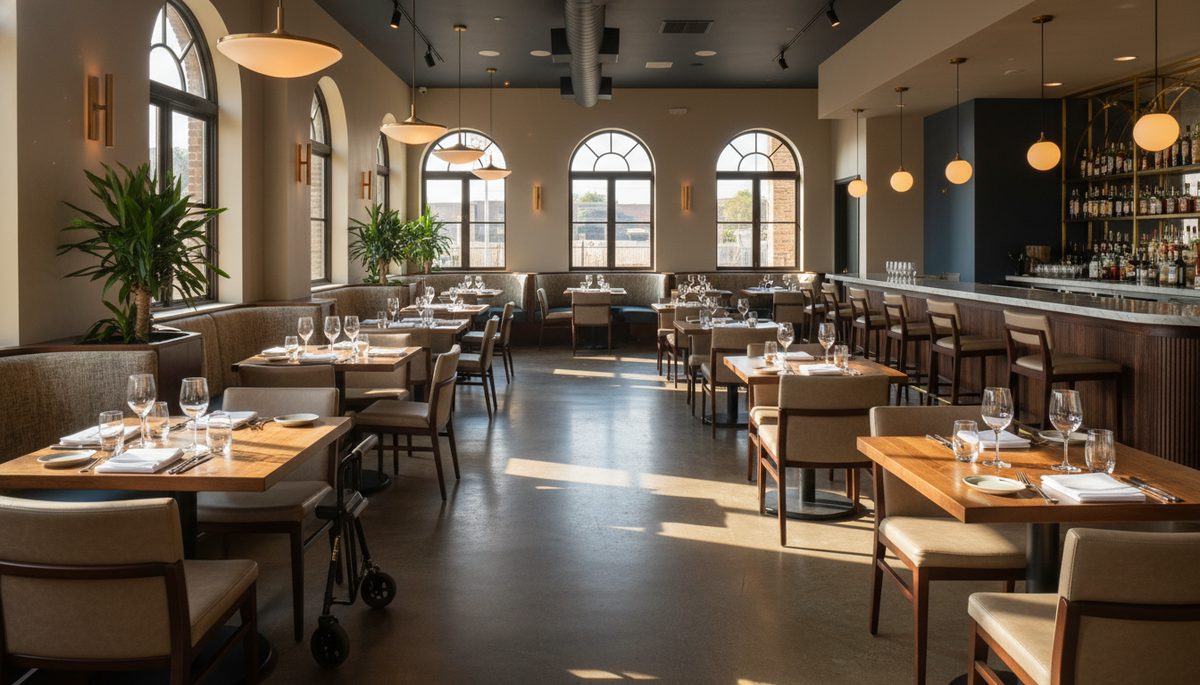
- Aisle width between tables. Primary circulation routes must maintain at least 36 inches clear. Restaurants that pack tables aggressively often miss this — especially after a renovation that "added a few more seats."
- At least one accessible dining section. Not just one accessible table at the edge — a representative portion of the dining experience must be accessible, including any outdoor, patio, or bar-height sections that are a meaningful part of your concept.
- Counter height. At least one section of the primary service counter (host stand, checkout, takeout counter) must be no more than 36 inches high for at least 36 inches of length.
Restrooms
- Turning radius and grab bars. 60-inch turning circle, side and rear grab bars at 33–36 inches above the floor. Sink knee clearance at least 27 inches high, 30 inches wide, 11–25 inches deep.
Digital
- Online menu and ordering flow. A PDF menu that is just a scanned image is inaccessible to screen readers — and is the single most common website violation we cite on restaurant audits. Third-party ordering platforms (DoorDash, Toast, etc.) carry their own accessibility profiles, but if you embed or link to one, your liability does not transfer to them.
What the fixes typically cost
- Re-striping parking + signage: $300–$1,200
- Door pull-force adjustment: $50–$300 per door
- Threshold ramp / replacement: $400–$2,500
- Grab-bar installation (two bars properly mounted): $300–$800
- PDF-to-HTML menu conversion: $200–$1,500 depending on menu complexity
A typical restaurant remediation, once a CIAC audit is done, totals between $2,500 and $8,000 — a lot of which is recoverable via the Section 44 tax credit.
ADA compliance updates, in your inbox
New posts, DOJ guidance, and lawsuit trends. No spam. One-click unsubscribe.